
DUBAI, UAE – (ARAB NEWSWIRE) — The healthcare sector in the Gulf Cooperation Council (GCC) is undergoing a historic metamorphosis. Driven by sweeping national transformation plans like Saudi Vision 2030, “We the UAE 2031,” and Qatar National Vision 2030, the region is rapidly transitioning from a consumer of imported medical services to a global incubator for health innovation, biotechnology, and localized pharmaceutical manufacturing. For public relations and marketing experts, this explosive growth presents a profound opportunity—and a complex challenge.
The volume of noise in the GCC healthcare space is deafening. Every week brings announcements of new mega-hospitals, genomic sequencing milestones, and multi-million-dollar HealthTech investments. To ensure that a brand’s message does not just become background static, PR professionals must abandon outdated, one-size-fits-all distribution models. Success in this high-stakes ecosystem requires a hyper-localized, intelligence-driven approach to press release distribution and media relations.
Here is how marketing and PR experts should architect their communications strategy for the GCC health industry.
- Decoding the GCC Healthcare Media Ecosystem
Before drafting a single press release, it is imperative to understand the architecture of the regional media landscape. The GCC is not a monolith; it is a highly nuanced matrix of hyper-local publications, pan-Arab broadcasters, and increasingly influential specialized B2B intelligence portals.
The Rise of Niche B2B Portals and Aggregators
Historically, PR professionals relied heavily on broad-spectrum national dailies. While these remain important for mass awareness, the real decision-makers—investors, government ministers, hospital administrators, and tech founders—are increasingly turning to specialized digital platforms. Niche B2B news aggregators that curate intelligence specifically on regional healthcare, AI, and finance are where high-value engagement occurs. Securing placement in a specialized portal that focuses explicitly on “Gulf Healthcare Intelligence” often yields a higher return on investment than a brief mention in a general news outlet, because the audience is entirely composed of relevant industry actors.
Bilingual Mandatory, Cultural Fluency Essential
English may be the language of international business, but Arabic is the language of regional governance and trust. Distributing a press release solely in English severely limits its reach and impact, particularly in powerhouse markets like Saudi Arabia. However, translation is not enough; localization is key. The tone, terminology, and formatting must resonate with Arabic-speaking professionals. A direct, literal translation often strips the narrative of its authoritative weight.
- Structuring the Campaign: The 12-Month Press Release Roadmap
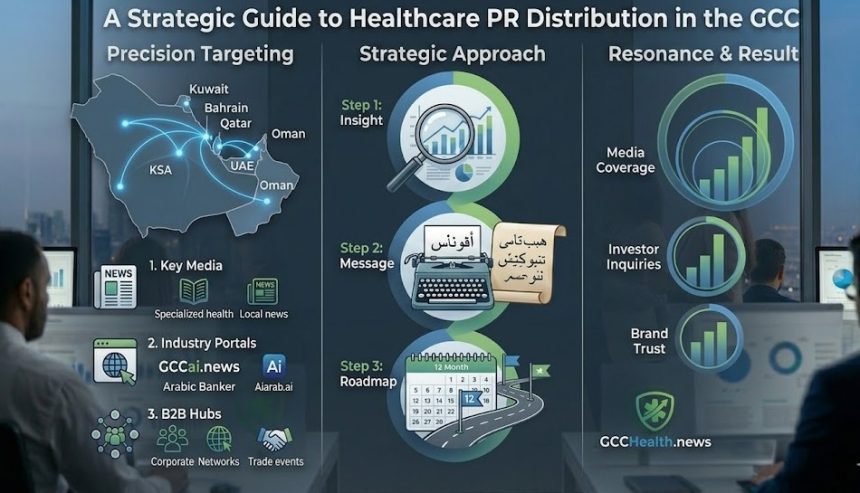
Ad hoc, reactive PR is a recipe for irrelevance. The most successful healthcare brands in the GCC operate on a meticulously planned 12-month press release roadmap. This proactive calendar ensures a steady drumbeat of news, keeping the brand visible to investors and partners without inducing fatigue.
A strategic roadmap should balance different types of announcements:
- Tier 1 (Quarterly): Major strategic milestones. (e.g., Opening a new biotech facility, securing a major government contract, launching a localized manufacturing plant).
- Tier 2 (Bi-Monthly): Partnerships, memorandums of understanding (MoUs), and clinical trial updates.
- Tier 3 (Monthly): Thought leadership pieces, executive appointments, and commentary on regional health trends.
By mapping these out over a year, PR teams can align their announcements with major regional events, such as Arab Health in Dubai or the Global Health Exhibition in Riyadh, maximizing earned media potential.
- Crafting the Narrative: Aligning with National Visions
In the West, healthcare PR often centers strictly on clinical efficacy, patient outcomes, or corporate profitability. In the GCC, the narrative must be broader. Every press release must implicitly or explicitly answer the question: How does this advance the nation’s strategic goals?
The “Localization” Angle
Governments across the GCC are fiercely focused on localization—building domestic supply chains, training local medical professionals, and achieving pharmaceutical sovereignty. A press release about a multinational pharma company opening a regional office is moderately interesting. A press release detailing how that same company will transfer knowledge to local scientists and manufacture active pharmaceutical ingredients (APIs) domestically is front-page news.
The Technology and Future-Proofing Angle
The region views healthcare through the lens of emerging technology. PR narratives should heavily emphasize the integration of Artificial Intelligence, genomic data, and digital health infrastructure. If a hospital is upgrading its systems, the press release should focus on how this contributes to building a smart, future-proof health ecosystem that aligns with the digital mandates of smart cities like NEOM or the broader digital governance frameworks of the UAE.
- Precision Targeting: Reaching the Right Stakeholder
A common mistake in regional PR is utilizing a “spray and pray” approach via broad wire services. While wires offer SEO benefits and a baseline of visibility, they rarely generate impactful, organic media coverage on their own.
Mapping the Influence Matrix
PR professionals must identify the exact stakeholder they are trying to influence with each release.
- Is the goal to attract sovereign wealth fund investment? The release should highlight market size, compound annual growth rate (CAGR), and regulatory compliance, targeted at financial and investment media.
- Is the goal to attract top-tier medical talent? The narrative should focus on cutting-edge research facilities, quality of life, and clinical autonomy, targeted at global medical journals and specialized health tech blogs.
Cultivating the Journalist
Building organic relationships is the cornerstone of effective PR in the Middle East. You cannot rely on a database to do the heavy lifting. PR experts must identify the specific journalist or editor who covers healthcare policy, biotech, or regional investments at target publications.
Before pitching a major release, engage with their recent work. When you do pitch, offer them something exclusive—an embargoed look at the data, a one-on-one interview with the CEO, or a customized localized angle that their competitors will not have. A respected regional journalist is an ally; treating them merely as a distribution node guarantees your release will be ignored.
- The Distribution Mechanics: Beyond the Wire
To penetrate the GCC market effectively, marketing experts must utilize a blended distribution architecture.
- The Strategic Wire: Use premium, localized wire services that have guaranteed syndication agreements with major Middle Eastern portals (e.g., Arab Newswire, ME NewsWire). Ensure the wire allows for multimedia attachments, as regional publications are highly visual and favor articles accompanied by high-resolution images, bilingual infographics, and executive headshots.
- Direct Pitching: For top-tier targets, bypass the wire entirely. Send personalized, concise pitches to editors. Keep the pitch brief, highlight the localized impact, and attach the full release and assets.
- Digital Amplification (LinkedIn): In the GCC, LinkedIn is not just a networking site; it is a primary news consumption platform for the B2B community. A press release strategy is incomplete without a corresponding LinkedIn amplification plan. The core announcements should be broken down into digestible, highly visual posts shared by the company page and, critically, by the C-suite executives themselves. Executive thought leadership on LinkedIn often generates more valuable stakeholder engagement than a standard wire syndication.
- Leveraging Specialized Hubs: Proactively submit news to the niche intelligence aggregators that focus on Gulf healthcare, AI, and regional economy. These platforms are constantly seeking high-quality, relevant B2B content to populate their specific categories (like HealthTech, Pharma, or Public Health) and are often more receptive to direct submissions than legacy media.
- Crisis Communications and Reputation Management
In the healthcare sector, the stakes for reputation management are uniquely high. PR experts must be prepared for the distinct regulatory and cultural sensitivities of the GCC.
Regulatory Agility
Health ministries across the Gulf (such as the MoH in Saudi Arabia or the DHA/DoH in the UAE) have strict guidelines regarding medical claims, advertising, and the promotion of therapeutics. A press release that is compliant in Europe or the US may violate local regulations in the GCC. PR teams must work in lockstep with local legal and compliance officers to ensure every claim is substantiated and culturally appropriate.
Tone and Sensitivity
The tone of healthcare communications should be authoritative, respectful, and deeply empathetic. When dealing with topics like public health crises, genetic diseases, or significant clinical failures, transparency must be balanced with absolute cultural tact.
- Measurement and Analytics: Proving Value Beyond Vanity Metrics
The era of measuring PR success by the raw number of syndications or “Advertising Value Equivalency” (AVE) is over. In the sophisticated B2B landscape of the GCC, marketing experts must track metrics that prove actual business impact.
- Share of Voice (SOV): How much of the regional conversation regarding “HealthTech” or “Biotech” does your brand command compared to competitors?
- Sentiment Analysis: Is the coverage overwhelmingly positive, neutral, or negative? Are journalists adopting your strategic messaging and key phrases?
- Stakeholder Engagement: Did the press release drive qualified traffic to your digital portals? Did it result in inbound inquiries from investors or potential partners?
By utilizing advanced media monitoring tools that parse both English and Arabic content, PR teams can provide actionable intelligence back to the C-suite, proving that their communication strategy is a driver of corporate growth, not just a cost center.
Conclusion
Distributing a press release in the GCC healthcare sector is no longer an administrative task; it is an exercise in high-level strategic intelligence. As the Gulf continues to build the healthcare infrastructure of tomorrow, the brands that succeed will be those that understand how to weave their corporate milestones into the grander narrative of regional transformation. By adopting a proactive roadmap, insisting on cultural and linguistic fluency, and targeting the specialized portals where real decisions are made, PR and marketing experts can ensure their message is not just distributed, but deeply understood.