
Introduction
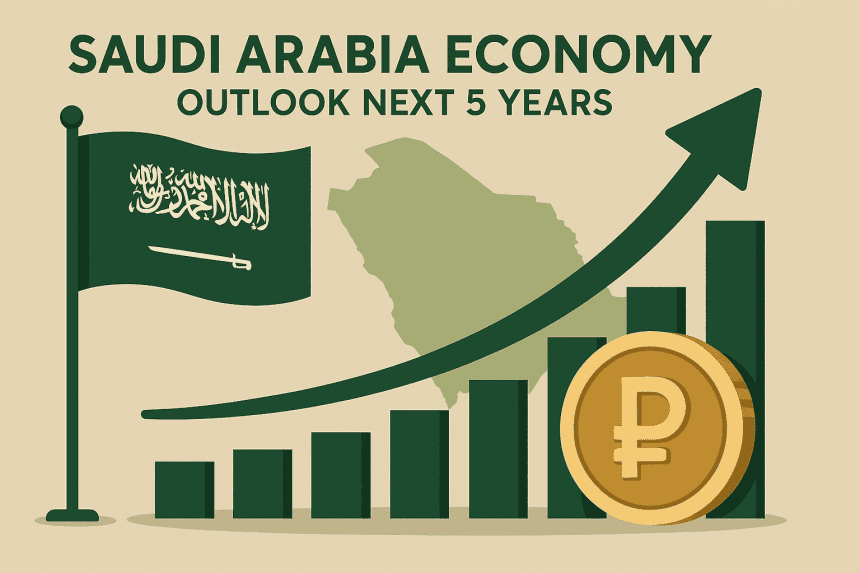
Saudi Arabia, the largest economy in the Middle East, stands at a transformative crossroads. Once reliant on oil, the Kingdom is now actively diversifying its economy through Vision 2030. This essay examines the trajectory of Saudi Arabia’s economy over the next five years, analyzing key sectors, reforms, challenges, and opportunities that will shape its future.
Current Economic Landscape (2025)
As of 2025, Saudi Arabia’s economy is experiencing moderate but resilient growth, driven by both oil and non-oil sectors. According to the International Monetary Fund (IMF), the Kingdom’s GDP growth is projected to reach 3.3% to 6% this year. The variance reflects global oil price fluctuations and the pace of domestic reforms.
Key Indicators:
- Oil Revenue: Still contributes approximately 61% of government income.
- Budget Deficit: Estimated at ~3% of GDP.
- Foreign Reserves: Exceeding $400 billion.
- Non-Oil GDP Growth: Forecasted at 4.4%, driven by tourism, retail, and finance.
Saudi Arabia’s economic strategy is increasingly focused on non-oil sectors, with tourism, real estate, and technology emerging as growth engines.
Oil Sector: Still Dominant, But Evolving
Despite diversification efforts, oil remains central to Saudi Arabia’s fiscal health. The Kingdom plans to expand its production capacity to 13 million barrels per day by 2027, reinforcing its role in global energy markets.
Strategic Developments:
- Saudi Aramco is investing over $200 billion in infrastructure and sustainability.
- Brent Crude Prices: Averaging around $75/barrel in 2025.
- OPEC+ Dynamics: Saudi Arabia continues to lead production decisions, balancing market stability with fiscal needs.
However, volatility in oil prices and geopolitical tensions pose risks to revenue stability. The Kingdom’s proactive approach to energy transition, including investments in renewables, aims to mitigate these vulnerabilities.
Vision 2030: Blueprint for Transformation
Launched in 2016, Vision 2030 is Saudi Arabia’s strategic framework to reduce oil dependency and build a diversified, sustainable economy. The next five years are critical for realizing its goals.
Core Objectives:
- Diversify income sources
- Empower citizens
- Modernize infrastructure
- Attract foreign investment
- Position Saudi Arabia as a global hub
Vision 2030 is not just economic—it’s social, cultural, and institutional. It seeks to redefine Saudi identity in a post-oil world.
Mega-Projects: Engines of Growth
Saudi Arabia’s economic transformation is anchored in giga-projects that aim to reshape urban life, tourism, and innovation.
Key Initiatives:
| Project | Description | Status |
|---|---|---|
| NEOM | $500B smart city integrating tech, sustainability, and tourism | Under construction |
| The Line | 170km car-free city with zero carbon emissions | Under review for feasibility |
| Red Sea Global | Luxury tourism and resort development | Ongoing |
| Qiddiya | Entertainment and sports hub | Expanding |
While these projects promise economic diversification, they also face cost concerns, execution challenges, and scrutiny over feasibility.
Tourism: A Rising Star
Tourism is one of the fastest-growing sectors in Saudi Arabia. In Q1 2025, the Kingdom ranked #1 globally in tourism revenue growth, with a 102% surge in international arrivals compared to 2019.
Strategic Goals:
- Attract 100 million tourists annually by 2030
- Increase tourism’s GDP contribution from 3% to 10%
- Host global events and festivals (e.g., Formula E, MDLBeast)
The easing of visa restrictions, cultural reforms, and infrastructure development are making Saudi Arabia a premier destination in the Middle East.
Real Estate & Foreign Investment
In a landmark move, Saudi Arabia will allow foreign ownership of real estate in designated zones starting January 2026.
Implications:
- Boosts foreign direct investment (FDI)
- Stimulates urban development in cities like Riyadh and Jeddah
- Aligns with Premium Residency Law and Vision 2030 goals
This policy shift mirrors successful models in Dubai and Doha, potentially positioning Saudi cities as real estate hotspots.
Technology & Innovation
Technology is a cornerstone of Saudi Arabia’s future economy. The Kingdom is investing heavily in AI, digital infrastructure, and smart cities.
Highlights:
- Oxagon: Industrial city focused on innovation and sustainability
- Trojena: Mountain resort integrating tech and eco-tourism
- SDAIA: Saudi Data and AI Authority driving digital transformation
These initiatives aim to position Saudi Arabia as a leader in the Fourth Industrial Revolution, attracting global tech firms and nurturing local talent.
Social Reforms & Human Capital
Vision 2030 emphasizes citizen empowerment, with reforms in education, healthcare, and workforce participation.
Key Developments:
- Female workforce participation has risen sharply
- STEM education and vocational training are being prioritized
- Human Capability Development Program aligns skills with market needs
These reforms are essential for building a competitive, inclusive economy that can thrive beyond oil.
Challenges Ahead
Despite progress, Saudi Arabia faces several hurdles in its economic transformation.
Major Risks:
- Oil price volatility impacting fiscal stability
- Execution delays in mega-projects like The Line
- Geopolitical tensions affecting investor confidence
- Labor market mismatches and youth unemployment
The Kingdom’s ability to adapt, innovate, and reform will determine the success of its Vision 2030 goals.
Projections for 2030
By 2030, Saudi Arabia aims to emerge as a regional powerhouse in tourism, technology, and sustainable development.
Expected Outcomes:
- Non-oil GDP share significantly increased
- Private sector driving majority of economic activity
- Global investment hub status achieved
- Smart cities and infrastructure integrated into daily life
If executed successfully, Saudi Arabia will become a model for post-oil economic transformation in the region.
Conclusion
Saudi Arabia’s economic outlook from 2025 to 2030 is one of ambition, recalibration, and transformation. The Kingdom is navigating a complex path—balancing its oil legacy with a bold vision for the future. Through strategic reforms, mega-projects, and social change, Saudi Arabia is redefining its place in the global economy.
If Vision 2030 is realized, the next five years could mark the dawn of a new economic era—not just for Saudi Arabia, but for the entire Middle East.
This article on “Saudi Arabia’s Economic Outlook: 2025–2030” is published and distributed by Arab Newswire™, part of GroupWeb Media Network. To reach a target audience with press release distribution in Saudi Arabia, GCC, Middle East and North Africa (MENA) or the Arab world, contact us at: 832-716-2363 or Telegram: @groupwebmedia